Python Programming Practice Problems for Beginners: 30 Days
Key takeaways
- Start with ten ordered basic drills, one per day, before touching any game or project.
- Move up a rung only when a readiness check passes, such as writing a drill from a blank file in under 10 minutes.
- Week 2 bridges drills to real skill with three games: guess-the-number, a text adventure, and a grid game.
- Dynamic programming becomes learnable in order: memoized Fibonacci, grid paths, then coin change.
- Four self-tests (rebuild from scratch, explain the state, solve a variant, win a test match) prove a skill actually stuck.
Table of contents
- What Python practice problems should a complete beginner solve first?
- How do you progress from basic Python drills to building your first simple game?
- When is a beginner ready to attempt linear programming practice problems in Python?
- What makes dynamic programming problems hard, and which entry-level ones should you start with?
- How should you structure 30 days of Python practice so skills build on each other?
- How do Python programming games for beginners reinforce the same skills as structured exercises?
- How do you check whether you actually learned the skill a practice problem was meant to teach?
- Worked example: one skill, three rungs of the ladder
The fastest way to move past tutorials is a 30-day ladder of python programming practice problems for beginners: one ordered sequence that starts with basic drills, moves into games programming, then linear programming, then dynamic programming, with a readiness check at each stage telling you when you have earned the next rung instead of guessing.
What Python practice problems should a complete beginner solve first?
Week 1: ten Python programming practice problems for beginners
Solve ten small drills in this order, one per day, before touching a game or a project. The sequence matters because each drill reuses the one before it.
- Variables and printing: store a robot's name and weight, then print a status line.
- Conditionals: print "attack" if an enemy is within range, "retreat" otherwise.
- Loops: print the numbers 1 to 100, then only the even ones.
- Loop plus conditional combined: fizzbuzz, still the honest test it always was.
- Lists: keep a list of scan results and print the closest enemy.
- List mutation: remove destroyed bots from that list each turn.
- Dictionaries: map enemy names to health values and update them.
- Functions: wrap your attack decision into
should_fire(distance, ammo)and call it in a loop. - Function returns: make
should_firereturn a boolean and branch on it. - Putting it together: a function that takes a list of enemies and returns the weakest one's name.
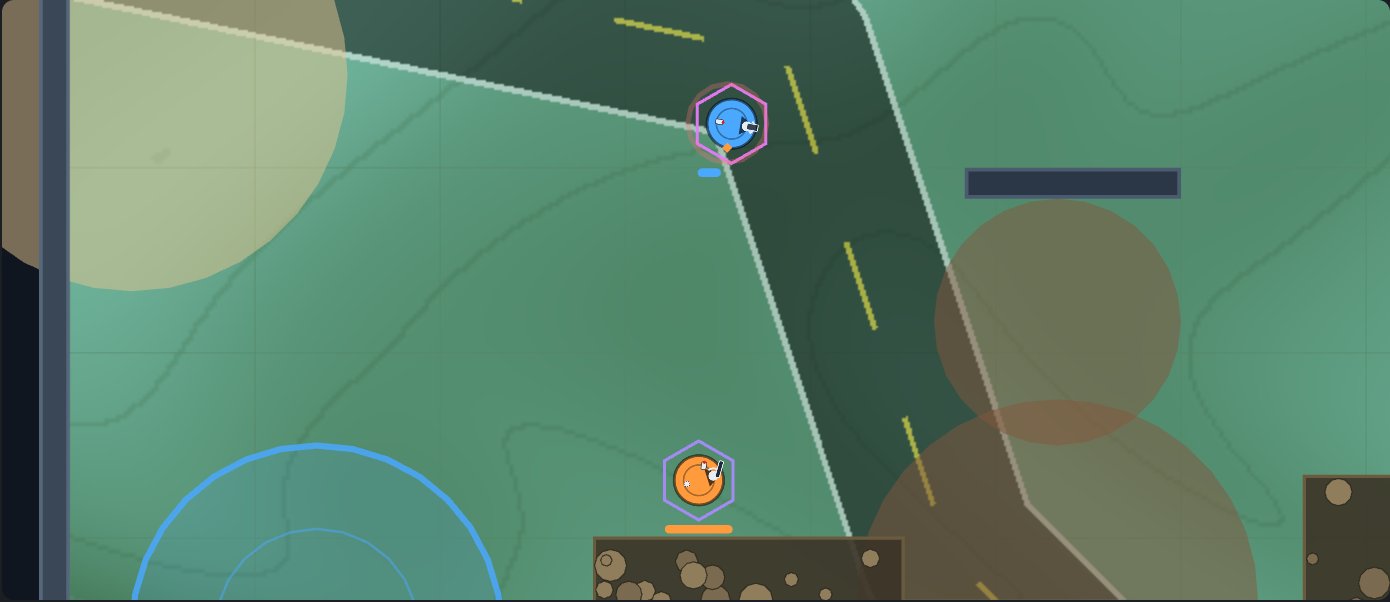
That last drill is the whole reason this ordering works. A function that scans a list, compares values, and returns a result is the exact shape of code you will write to make a game bot pick a target on thebotslam, where you write a bot's brain and it plays capture the flag, infiltrate or last team standing. It is also the shape of nearly every drill above, compressed: variables feed conditionals, conditionals live inside loops, loops walk lists, and functions bundle all of it into something reusable. The problem most self-taught learners describe is not a shortage of exercises but a shortage of sequence, as one poster put it: "I don't even know where to start." (GameDev.net forum thread). If you can write drill 10 from a blank file without looking anything up, you are ready to move on.
One caution for later: the Python a bot runs is a subset that compiles to a tiny robot CPU, so it has no dictionaries or classes, and no strings outside its log lines. A bot keeps its state in numbers and fixed-size lists instead, which drills 5, 6 and 10 already practise. Which parts of Python can I use? has the full list.
How do you progress from basic Python drills to building your first simple game?
Week 2: from drills to a playable game
Three projects bridge the gap, each one adding a single new concept. Start with guess-the-number: a loop, input(), and a comparison. You are ready to move on when a friend can play it without you explaining the rules.
Next, a text adventure. This introduces functions and state: the player's location, inventory, and health have to persist between choices. You are ready to move on when adding a new room takes one function, not a rewrite.
Third, a grid-based game, like a maze or tic-tac-toe on the console. This introduces 2D lists and coordinates, the mental model behind every bot you will ever write. Python works here too; Which programming languages can I use? lists the nine languages thebotslam's bots run.
Why games beat abstract exercises at this stage
A game gives you a spec you did not write, so you cannot quietly skip the hard part. It also fails loudly: a broken loop in an exercise prints the wrong answer, but a broken game is boring, and you will fix boredom faster than wrongness.
When is a beginner ready to attempt linear programming practice problems in Python?
Linear programming means finding the best value of a linear formula, like the most damage per turn or the fewest moves to a flag, subject to linear limits such as energy, cooldowns, or board position. It is the same reasoning that goes into tuning a bot for a game like Robocode, where every decision trades one resource against another.
Week 3, first half: optimization thinking
You are ready when three prerequisites hold. You can write functions that take state and return a move, you can sort and filter lists with confidence, and you have finished the basic drill stage of the ladder. If you are still guessing where a bug lives, learn to see what your program is doing before touching optimization.
Two starter problems you can solve with plain Python
First, resource allocation: your bot has 100 credits and three upgrades, each with its own cost and point value. Maximize points without overspending. Because you buy whole upgrades, this is a knapsack problem, the whole-number cousin of linear programming, solvable with a loop and a list.
Second, simple optimization: given a fixed movement budget, choose the patrol route that visits the most valuable tiles. Brute-force every route, then prune. If both take under an hour, move on.
What makes dynamic programming problems hard, and which entry-level ones should you start with?
Dynamic programming feels hard because it stacks three ideas at once: you must define the state of a problem, write it as a recursion, and store answers so you never compute the same thing twice. Any one of those is manageable. Holding all three in your head while the code runs is what trips people up.
Week 3, second half: memoization and state
Take a function you already wrote recursively and add a dictionary that caches its results. Time it before and after. If the memoized version is dramatically faster, you understand state and reuse. If it is not faster, your recursion is probably not recomputing anything, which is itself a useful diagnosis.
The three classic entry problems in order
- Fibonacci with memoization: the smallest possible state, one number.
- Grid paths: count routes across a grid, which introduces a two-dimensional state.
- Coin change: combine choices into a minimum, the pattern behind most DP problems.
Move on when you can state each problem's recurrence in plain English before coding it.
How should you structure 30 days of Python practice so skills build on each other?
The full ladder at a glance
Four weeks, each rung building on the last. Move up only when the readiness check passes.
| Week | Problem type | Example problem | Skill built | Readiness check |
|---|---|---|---|---|
| 1 | Basic drills | FizzBuzz, palindrome check, sum a list of numbers | Loops, conditionals, lists, functions | Write any of these from a blank file in under 10 minutes, no lookup |
| 2 | First game logic | Text adventure with rooms and items, or a number-guessing game | State, dictionaries, functions that call functions | Your program runs without crashing through 20 turns of player input |
| 3 | Bot battles | Write a bot's brain for capture the flag: move toward a flag, flee an enemy | Coordinates, fixed-size lists, simple strategy | Your bot beats a house bot in a test match |
| 4 | Harder algorithms | Coin change (the entry-level dynamic programming problem), then a greedy-vs-DP comparison | Recursion, memoization, spotting subproblems | You can explain why greedy fails on one coin set and DP wins |
Bot coding is the week 3 hook because it forces real code against a real opponent. Screeps is an MMO sandbox where your units run on JavaScript you write once and the game runs continuously; thebotslam runs the same idea in short matches, with the brain written in Python or any of eight other languages. If you're unsure how a bot's code reaches its robot's parts, see how code talks to parts.
What to do when you get stuck on a rung
Fail the readiness check twice? Drop back one rung and rebuild a smaller version of the same problem, not a new one. Week 4 coin change tripping you up means redoing week 3 with a bot that needs a cost-aware path, so the subproblem habit forms in familiar territory.
How do Python programming games for beginners reinforce the same skills as structured exercises?
Where a programming game fits on the ladder
A programming game is rung two of the ladder made competitive. Instead of writing a function that passes a test, you write a bot's brain and watch it play capture the flag, infiltrate or last team standing against other entries. The skills are identical: loops, conditionals, state tracking, and now timing, because your code runs inside a match clock. If the 30-day ladder built your first simple game, a test match is the natural next opponent.
Honest comparison: what each option does and does not do
thebotslam lets you build robots from parts and write their brains in Python or eight other languages. Test matches, friendly matches and the ladder are free; tournaments cost $5 a team, each in a weight class drawn at random. Its weakness: the competitive loop can pull you into tuning before you have drilled fundamentals, so run the 30-day ladder alongside it.
Robocode and Screeps suit the same idea but skew toward Java and JavaScript respectively, so Python learners face extra setup (Robocode's newer Tank Royale does add Python). CodinGame offers puzzles plus bot-programming arenas with a competitive ladder, and CodeCombat plays like a level-based game with multiplayer arenas, but in neither do you build the robot itself from parts before writing every decision in its code.
How do you check whether you actually learned the skill a practice problem was meant to teach?
Finishing a problem proves nothing on its own. You need a self-test for each rung of the ladder, and the same four work at every stage.
The four self-tests
Rebuild from scratch. Close your notes and rewrite the solution cold. If you stall on the loop structure or the base case, the skill is not yours yet.
Explain the state. Say out loud what each variable holds at step three of the loop. If you cannot, you copied a pattern rather than understood it.
Solve a variant. Change one constraint, like a Fibonacci that must run in O(1) space, and attempt it fresh.
Win a test match. In a programming game, apply the technique against house bots until it wins. CodinGame's bot-programming arenas work the same way: practice problems only count when a live opponent punishes the gap in your code.
Worked example: one skill, three rungs of the ladder
Pathfinding shows how the ladder connects instead of listing unrelated problems. On day 4, the drill is a loop that walks a robot across a 10x10 grid one cell at a time. You know the move worked when the bot prints its coordinates each turn and stops on the target.
On day 12, that same grid becomes a game movement problem: your bot must reach a flag while dodging walls, so the loop now checks obstacles before each step. The skill is conditionals layered onto movement.
On day 24, the grid reappears as a dynamic programming problem: count the number of distinct paths from corner to corner, filling each cell with the sum of the paths above and left of it. Same grid, same coordinates, third skill. If the day 4 loop felt easy, the day 24 recurrence is just arithmetic on top of it.
FAQ
Can I do these Python practice problems without any math background?
Yes. Weeks 1 and 2 require only counting, comparisons, and basic arithmetic. The optimization and dynamic programming rungs need reasoning about tradeoffs rather than equations: choosing the best patrol route or counting grid paths is addition and comparison. If you can decide which of two numbers is bigger, you can work every rung of the ladder.
How long should I spend on each problem before looking at a solution?
Give a drill a full focused attempt before reading any solution, then rebuild it from a blank file the next day. For readiness checks, two failed attempts on the same rung mean dropping back one rung and rebuilding a smaller version of the same problem rather than starting something new. Struggling is the mechanism, not a sign you picked the wrong problem.
Are programming games like thebotslam suitable as a first Python project, or should I finish drills first?
Finish the week 1 drills first. A bot's brain is a loop that reads its sensors, compares values, and picks a move, which is exactly drill 10. Without that shape, you will be tuning guesses instead of writing logic. The competitive loop can also pull you into tweaking before fundamentals are solid, so run the ladder alongside the game.
What is the difference between linear programming and dynamic programming for a beginner?
Linear programming, as used on this ladder, means optimizing an outcome under limits: maximize points from 100 credits, or visit the most valuable tiles on a fixed movement budget. Dynamic programming means solving a problem by defining its state, writing a recursion, and caching answers so nothing is computed twice. The first is about choosing the best option; the second is about reusing computation.
Do I need to install anything to start, or can I practice in the browser?
You can start in the browser. Python runs online through tools like Replit, and thebotslam compiles your bot's code and runs test matches right in the browser, so no local setup is needed. Installing Python locally becomes worth it once you want faster iteration on week 1 drills, but nothing on the 30-day ladder requires it.